





The work recognised by this year’s Nobel Prize in Economic Sciences is particularly relevant at a time when many countries are facing economic instability arising from external supply shocks, geopolitical tensions, trade disputes and the effects of globalisation. These pressures renew the need for policies that can cushion economies against adverse shocks and support macroeconomic stability.
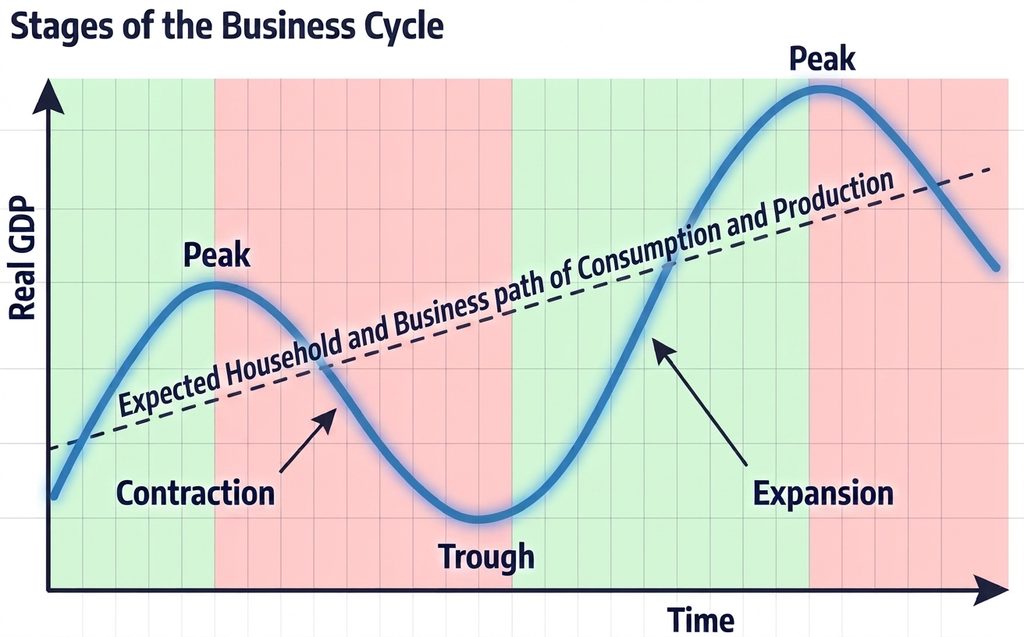
The contributions of Robert E. Hall and Michael Woodford offer a useful way of thinking about this challenge. Their workplaces individual behaviour and expectations at the centre of macroeconomic analysis. Hall’s research examines how households make consumption decisions based on expected future income, while Woodford’s work explains how expectations influence price-setting and the effectiveness of monetary policy. Together, these contributions reinforce the importance of understanding how households and businesses respond to information and anticipated policy changes to smoothen their consumptive and investment paths. In the image below the straight line is illustrative of what stabilisation policy sets out to achieve overtime in different stages and events of the economy.
Understanding Household Consumption
Hall’s contribution focuses on household consumption behaviour, building on the Permanent Income Hypothesis associated with Milton Friedman. The hypothesis proposes that individuals make consumption decisions based not only on their current income but also on their expectations of income over their lifetimes. In other words, households consider their expected future financial position when deciding how much to consume today. Consequently, a temporary increase in income may not produce the same change in consumption as a permanent increase.
Hall extended this reasoning by examining the implications of forward-looking consumption decisions. If individuals make decisions using all the information available to them, their current consumption should already reflect what they know about their expected future income. Therefore, changes in consumption should largely be driven by new, unexpected information rather than by information that was already available.
Expectations and Monetary Policy
While Hall concentrated on household consumption decisions, Woodford developed a framework explaining how expectations influence the broader economy and the effectiveness of monetary policy. His work became a major foundation of modern New Keynesian macroeconomics.
Consider a central bank attempting to reduce inflation by increasing interest rates. Higher interest rates generally make borrowing more expensive, discouraging consumption and investment. This reduces aggregate demand and, in turn, inflationary pressure. However, monetary policy operates through more than the immediate adjustment of interest rates. Households and businesses are forward-looking: they anticipate future economic conditions and adjust their decisions accordingly. A household expecting higher borrowing costs may postpone taking out a loan, while a business anticipating weaker demand may delay an investment. Similarly, a company expecting higher production costs may adjust its prices in advance. Monetary policy therefore influences economic activity not only through what the central bank does today, but also through what economic agents expect it to do in the future.
The Importance of Communication and Credibility
The applicability of this framework differs between developed and developing economies. In developed economies, relatively efficient financial markets and liquid bond markets can provide signals about market expectations. In many emerging and developing economies, however, financial markets may be illiquid, participation may be limited, and financial-market activity may be weakly connected to the wider economy. Where large sections of the population have limited access to formal savings and credit, their spending decisions may respond only weakly to changes in interest rates.
This is particularly relevant in an economy with a large informal sector. The ZIMSTATS document’s estimate that approximately 75% of establishments operate informally, many of them micro, small and medium-sized enterprises (MSMEs), points to a potential limitation in the reach of conventional monetary policy. Businesses with limited access to formal credit and savings are less directly connected to the financial system. As a result, changes in policy rates may have a limited effect on their borrowing costs and spending decisions. Interest-rate adjustments may therefore affect a smaller segment of the economy than policymakers intend.
Woodford’s framework also recognises that prices do not always adjust immediately when economic conditions change. This is known as price stickiness. However, if a producer expects increases in production costs, that expectation may influence today’s pricing decision. Expectations about future economic conditions can therefore influence present-day prices and contribute to inflation dynamics.
This brings the discussion to the role of monetary-policy communication in Zimbabwe. Since 2024, the Reserve Bank of Zimbabwe (RBZ) has communicated its monetary-policy decisions and outlook through Monetary Policy Statements (MPS), Monetary Policy Committee (MPC) communications and quarterly updates. These communications provide information on policy measures, inflation developments, exchange-rate conditions, foreign-currency reserves and the Bank’s intentions regarding monetary stability.
For instance, discussion of a 2030 deadline for adopting the local currency, the ZiG, as the sole legal tender has had implications for market expectations. Financial intermediaries, particularly commercial banks, reportedly began shortening the tenures of US-dollar loans, moving away from longer-term lending. Short-term borrowing is generally more expensive than comparable long-term borrowing, which can constrain the mobilisation of capital. The RBZ subsequently sought to reassure the market by indicating that any transition would be guided by economic fundamentals rather than by an arbitrary date.
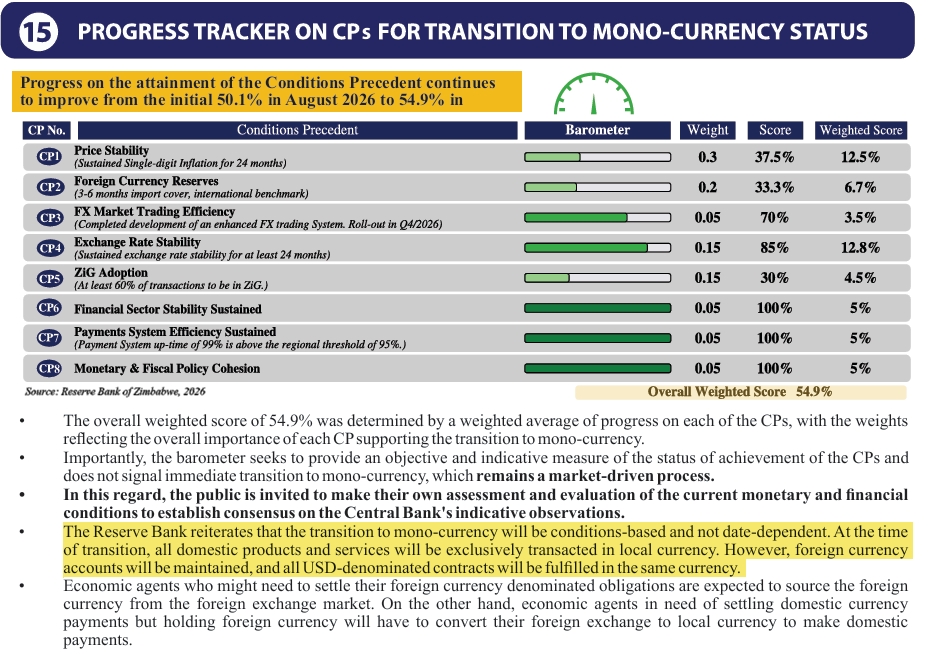
The RBZ has also communicated what it describes as “Conditions Precedent” in its periodic snapshot reports. According to the Bank, eight conditions must be met before the currency transition can take place, with three reportedly having been met. The conditions do not necessarily carry equal weight: price stability appears particularly important, alongside foreign-currency reserves, exchange-rate stability and the adoption of the ZiG. The Bank has indicated, for example, that ZiG adoption would need to reach at least 60% of transactions. The status of the remaining conditions is therefore likely to remain important to market participants seeking guidance on the timing and feasibility of the transition.
The relevance of Woodford’s work is that communication is not simply an announcement of policy decisions; it can itself influence economic behaviour. When a central bank clearly communicates its policy direction and the reasoning behind its decisions, households and businesses have information with which to form expectations. For example, if businesses believe that the RBZ is committed to maintaining monetary stability, they may be less inclined to build persistent inflation expectations into their pricing decisions. However, the effectiveness of communication depends on credibility: economic agents must believe that the Bank’s actions will be consistent with its stated intentions.
Concluding Remarks
The theoretical and empirical contributions of Hall and Woodford offer important insights for policymakers, financial institutions, central banks and governments. They demonstrate why macroeconomic policy should not be understood solely through aggregate relationships, but must also account for the decisions of individual households and businesses. These economic agents are forward-looking, using available information and expectations about future economic conditions and policy interventions to guide decisions on consumption, saving, investment and pricing.
Consequently, policymakers must recognise that individuals do not simply respond to policies after they are implemented; they also anticipate policy decisions and adjust their behaviour in advance. For Zimbabwe, this raises an important question: to what extent do RBZ communications shape the expectations and decisions of households and businesses, and do those responses contribute to monetary stability? The answer depends not only on what the central bank announces, but also on whether its commitments are credible and whether they influence behaviour across the wider economy. Stability, therefore, requires more than announcing policy intentions; it requires building the credibility and transmission mechanisms through which those intentions can affect economic decisions.