

How do nations, particularly emerging economies, achieve sustained economic growth? This was basically the question three Nobel laureates in economics—Joel Mokyr, Philippe Aghion, and Peter Howitt—answered in their research, which won the Nobel Prize in Economics in October 2025. The highest accolade amongst economists, which honors deep thinkers in the field of economics that have dedicated time, effort and practical insights.
Innovation was and is the foundation for all technological progress that has enabled higher living standards relative to a century past. Global national output growth in the 1700s moved sideways until the dawn of the industrial revolution, when growth began to move up and to the right exponentially along with living standards. This sudden rise isn’t just a sudden stroke of luck but is attributed to a set of factors that came into play before technological progress was realized.
Nobel Prize in Economics
The Sveriges Riksbank Prize in Economic Sciences in Memory of Alfred Nobel, an award for outstanding economic research, was given to three gentlemen for their extensive joint research on the prerequisites for sustained economic growth over time and the formulation of a growth model that provides an explanation of how not only capital accumulation determines growth but also innovation.
Joel Mokyr received half the prize for his work articulating the prerequisites necessary for sustained economic growth. His approach to his research was of an economic historian, looking into past behavioral systems and events. Simply put, Mokyr denoted that cumulative technological progress was and is the result of innovation, and innovation came about with the result of the following:
- Propositional Knowledge
- Prescriptive Knowledge
- The Diffusion of Knowledge
Knowledge, powerful if utilized wisely, comes in two forms which Mokyr labeled as propositional knowledge and prescriptive knowledge. Propositional knowledge is a form of knowledge characterized by undertaking scientific and theoretical approaches to why and how things worked the way they did. But chiefly this was mainly just theory, it had its flaws—it only ended in theory, which didn’t do much but add to theory and nothing toward material productivity.
The next form of knowledge necessary to compound toward achieving innovation was prescriptive knowledge, embedded mostly in artisan work. Individuals with certain know-how to handle tools and crafting meet the description of this form of knowledge. These two forms of knowledge back in the day were completely out of sync but later collaborated.
In terms of idea generation, brainstorming, as well as peer review Mokyr spoke of the diffusion of knowledge. For instance, Mokyr mentioned in his past books of the Republic of Letters, a somewhat circle of intellects where research papers and ideas were shared, reviewed, studied, and criticized. These mainly circulated in the Euro-zone, which is believed to be one of, amongst quite a number of reasons why Britain experienced the first industrial revolution popularly known as the Age of Enlightenment.
Philippe Aghion and Peter Howitt, on the other hand, developed the concept of creative destruction initially brought about by Joseph Schumpeter back in the 1900s. The two economists approached their research mainly by focusing on modern-day capitalist dynamics, the concept of creative destruction, and the driving force (profits). They developed a model that aimed to show how new, superior business models and products replace old systems and products to create sustained innovation and progress. The model describes an economy where final output is produced using capital as an input and the accumulation of capital is required to generate economic growth. The main results of the model show that capital accumulation and innovation are essential inputs to long-run growth:
More innovation stimulates capital accumulation by raising the marginal product of capital. Capital accumulation stimulates innovation by raising the profits accruing to a successful innovator, which runs completely contrary to the conventional belief that capital accumulation alone can determine long-term growth. This becomes a cycle of cumulative improvement, technological progression, and economic growth that filters down to a micro-individual level.
The critical use case of their research sets a basis for how AI policy should be carefully considered and structured. AI, ‘the 4th industrial revolution’, as a new technology that is yet to be fully integrated into the economic and financial systems, is set to replace obsolete and tedious technologies already in place. The research of the three award winners couldn’t be timelier, seeing as the world is still going back and forth on how the new AI era will shape the general public’s present and future.
Innovation in Africa has not seen much breakthrough products that Europe, the American continent, or Asia have experienced. However, we cannot completely rule out the continent because of some outliers but however it remains a fact that the continent is punching below its weight. Taking a glance at some data, we investigate the Global Innovation Index (GII). This Index ranks countries by looking at seven main factors, namely:
- Knowledge & Tech Outputs – Patent applications, hi-tech manufacturing
- Human Capital & Research – Researchers per million population, global corporate R&D investors
- Business Sophistication – Knowledge-intensive employment, university-industry R&D collaboration
- Market Sophistication – Finance for startups, venture capital received
- Creative Outputs – Trademark applications, global brand value
- Infrastructure – Environmental performance, information and communication technology access
- Institutions – Regulatory quality, policies for doing business
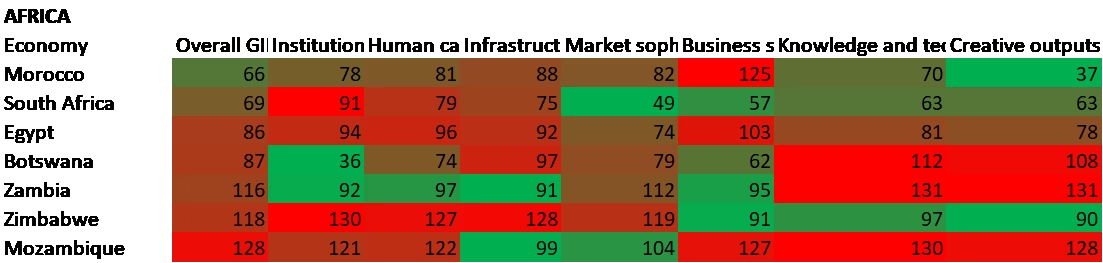
Source: WIPO (World Intellectual Property Organization)
In Africa ranked the highest is Morocco, ranked 66th, South Africa coming in second ranked 69th and you can only imagine where Zimbabwe comes in, as shown above it ranks 118th out of 133 countries. It scores terribly in institutions (130). The regulatory quality or policy for doing business is still not yet in place and with most well-established businesses still voicing the cost of formalization as being too high and burdensome. Infrastructure, such as digital connectivity, electricity and the internet, necessary for modern-day innovation, is little to almost non-existent for the majority and this score a value of 128. Even before considering these, there is a deficit of human capital researchers—deep thinkers—to carry out rigorous research and development, be it in private or public institutions. If there be such individuals they may be or may have exited to greener pastures abroad– brain drain. Why is this so? Incentives! Most importantly the funding ecosystem, innovators that require the necessary funding for their operations may find it difficult to acquire funding due to the high cost of borrowing and probably un-available funding. These critically need addressing before realizing sustained economic growth.

Source: WIPO
But what comes as a surprise to me is Switzerland, ranked 1st in the GII. The landlocked country neighboring to France, Italy, Austria and Germany is ranked the 1st in its knowledge and technology output as well as its creative outputs. Switzerland, I guess for me, isn’t much of a headliner that you hear on the news everyday be it political or economic, nothing! But the country, based on the provided data is technically sound in its institutions, seems to have one of the best human capital, intact infrastructure base essential for innovation, market sophistication amongst the top five out of 133 countries and a good business environment. The diagram above shows the top 5 ranking, Sweden being the 2nd, the USA at 3rd, Singapore ranked at 4th and the UK at 5th.
To conclude, emerging economies particularly African countries that identify as commodity-based economies which face external risks of falling global prices that are not within their control, need to shift from a commodity based to some what a service based rather. Therein lies the need to innovate, to rid with the old stagnate systems and shift to the new ones. Economic growth shouldn’t be taken for granted. The path to sustained growth runs through innovation and creative destruction, but it takes courage and wisdom to build and political or social will to resist forces of stagnation. Joel Mokyr, Phillipe Aghion and Peter Howitt did a stellar job at providing an explanation of the Hockey stick growth curve in the world economies.